Baksa Kembang dance including classical dance types, which survive and thrive in the palace of Banjar, which is danced by the daughters of the palace. This dance gradually spread to the people of Banjar with dancers galuh-galuh Banjar. This dance is performed to entertain the family palace and greeted guests like a king or a noble prince.
After this dance popular in the community in the Land of Banjar, serves to welcome guests state officials in the celebration of the great days of regional or national. Beside that also dances performed in Baksa Kembang Banjar wedding celebration or a celebration such as a host of safety. This dance wearing a pair of hand properties is developing a series of flower Bogam roses, jasmine, and ylang kantil. Bogan flowers will be awarded to guests officials and wife, after it finished taraian danced.
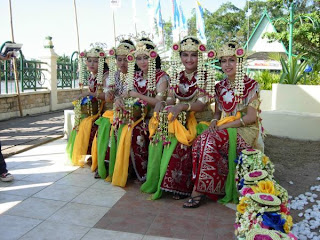
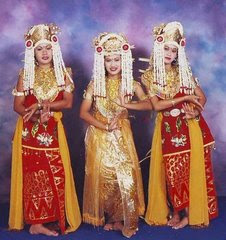
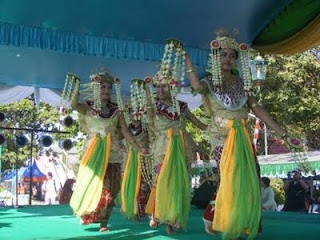
For a brief description, this dance describes teenage daughters beautiful playing in the garden of flowers. They picked some flowers and then assembled into flower blossoms bogam then they bring this bogam enjoying themselves while dancing with a supple. Baksa Kembang dance wear named Elephant Gemuling crowns carved by the flowers that shake, a pair of small bogam flowers placed on the crown and strand woven from coconut leaves called halilipan. Baksa Kembang dance is usually danced by a number of odd count as one person, three people, five men and so on. And is accompanied by a set dance or gamelan tetabuhan to the tune of the song is standard sieves and Janklong or Kambang Muni.
Baksa Kembang dance is in the Banjar society there are several versions, this happens every offspring has an individual style but is still a characteristic of the dance Baksa Kembang, like Lagureh, TAPUNG Rope, Kijik, Jumanang. In the 1990s, South Kalimantan Cultural Park gathering berinisiaf dance coaches from all Baksa Kembang to make a version of Dance Baksa Kembang standard. Once there is agreement, then the Dance diadakanlah workshoup participants Baksa Kembanag with representatives from local districts and municipal in South Kalimantan. Although there was a dance dance Baksa Kembang existing version but only revolves around the family or local, but in competitions, festivals or artistic mission out of the South Kalimantan have been dancing for a standardized.
A traditional art called "summons" has grown and developed in Central Aceh regions, especially in Gayo society. Gayo natural hinterland lies Nanggroe Aceh Darussalam Province. Saman dance itself was born ± XIV century, until today is still growing and still in its original form, which is almost in every village in this region warrant tersebut.Tarian created and developed by an Islamic religious leader called Sheikh Saman, so the name of the dance similar (synonyms) creators own name
Saman dance is the development of the art of dance, which originally was called "Pok pok Ane" is singing a poem to the accompaniment of clapping hands, pat his chest and thigh slap. Then by Sheikh Saman Pok pok Ane art is altered and embellished with various variations. There was movement applause, pat your chest, thigh with his right hand and left, changing the turn, so was born Sarah saman Uman, Manjik Saman and others. Saman dance can be classified as entertainment / performances, because performances of dance is not bound by time, event or a particular ceremony. Can be displayed at every opportunity that is noise and joy.
Saman own poems used in Arabic and Aceh. Before the start of a warrant mukaddimah or opening, appears a wise old man or a traditional leaders to represent the local community (keketar) or advice that is useful to the players and spectators. Songs and poems together disclosure and continuous, the players consist of men who are still young by wearing traditional clothes. Presentation of the dance can also be performed, the match between the group with a group guests sepangkalan (two groups). Assessment emphasis on the ability of each group in following the movements, dance and song (poetry) presented by the opposition.
Tari Saman is the delivery of ideas that contains the values of education as a whole. Thus, saman dance play an important role in the socio-cultural life of the Indonesian nation. In this perspective saman dance that developed in the province of Aceh, Gayo tribe in particular can give a positive contribution in the culture of the Acehnese people. especially in the arts of life, local language and local customs in Aceh. In addition, saman dance has been able to contribute to moral education and religious fields. In each appearance, speakers track always instilled good qualities, both moral view or religious views.
Kecak is often called "The Monkey Dance" for the tourists is a dance in a relatively new form of drama but the show has become a very popular / famous and has become a must watch show for tourists both domestic and abroad. Dance scenes kecak been promoted in several poscard, tourist guide and others.
Kecak is the name is a name that directly taken after the sound "cak, cak" in saying that continually throughout the show. There are some who explained that the word or sound "cak" actually means a very important and significant in the show.
Not known for certain where the dance originated and where kecak was first developed, but there is a kind of consensus on the Bali kecak first time developed into a performing arts in Bona, Ganyar, as additional knowledge kecak initially a tembang or produced music from the sound synthesis which form the melody is usually used to accompany the sacred dances Sahyang. And can only be performed in the temples. Then in the early 1930s from the village astist Bona, Gianyar trying to develop kecak dance by taking the story of Ramayana as a substitute didramatarikan Trance Dance that dance is ultimately can be displayed in public as performance art. Part of the Ramayana story was first taken in which the Goddess Sita was abducted by King Ravana.
As a Kecak performance is supported by some very important factors, more is more in this kecak show presents dance as an introduction to the story, of course the music is vital to accompany the dancers sway lenggak. But in the Kecak music sounds generated from a combination of peak, amounting to around 50 to 70 people it will make music akapela, a leader will act as the initial tone memberika longer act as a stressor in charge of high pressure or low tone of an act as a solo singer, and another will act as the mastermind who brought ki storyline. Kecak dance dancer in the movement should not follow the standard are standard dance accompanied by gamelan. So in this kecak dance dancer's body movements more relaxed because the main priority is the story and voice synthesis.
Basically there are five versions of the popular story that developed in the community about the origin and Warok Reog, but one of the most famous story is the story of the rebellion Ki Ageng Flea, a royal servant during Bhre Kertabhumi, the last king of Majapahit who ruled in the nineteenth century -15. Ki Ageng Flea wrath will strongly influence from the Chinese partner in the government and the king, the king of a corrupt behavior, he saw that the power of the Majapahit kingdom will end.
He then left the king and established the university where he taught young children martial arts, science self immunity, and the science of perfection in the hope that young children will become the seed of the resurrection of the Majapahit kingdom again later. Realizing that his army is too small to fight the royal troops Ki Ageng political message conveyed by fleas Reog performing arts, which is a "hint" to the king and his kingdom Kertabumi Bra. Cultural Reog a way Ki Ageng Flea local communities to build resistance using Reog popularity.
Reog performance shown in the shape of lion-head masks, known as the 'Lion Barong ", the king of the forest, which became the symbol for Kertabumi, and above attached peacock feathers to resemble a giant fan that symbolize the strong influence of his Chinese colleagues who set up all the motion - bearing. Jatilan, played by groups of dancers who gemblak horse riding became a symbol of the strength of troops into the kingdom of Majapahit contrast ratio warok strength, which is behind the red clown mask that became the symbol for Ki Ageng Lice, alone and support the weight of the mask reaches more singabarong of 50kg using only his teeth. Ki Ageng Reog popularity eventually led Kertabumi Lice take action and attack the school, the rebellion by warok quickly resolved, and universities to continue teaching prohibited to warok. But the students remained lice Ki Ageng continue secretly. Even so, Reognya own art is still allowed to be staged because the show has become popular among the people, but the story has a new line where the added characters from folklore Kelono Sewondono Ponorogo ie, Goddess Songgolangit, and Sri Genthayu.
Official version Reog Ponorogo storyline now is the story of King Ponorogo daughter who intend applying for Kediri, Dewi Ragil Yellow, but amid the journey he was intercepted by King Singabarong from Kediri. Singabarong king's army consists of peacocks and lions, while the part of the kingdom of King Ponorogo Kelono and deputy Bujanganom, escorted by warok (men dressed in black in the dance), and warok has a deadly black magic. The whole dance is a dance of war between the kingdom and the kingdom of Kediri Ponorogo, and pitted black magic between them, the dancers in a state of 'trance' while performing the dance.
Until now people Ponorogo only follow what their ancestral heritage as a cultural inheritance which is very rich. In the experience of art is the copyright Reog human creations that form the existing faiths were hereditary and awake. The ceremony also use terms that are not easy for lay people to meet without a clear lineage. they embrace Parental lineage and customary law which is still valid.
Pendet initially a worship dance that many exhibited in the temple, where worship of Hindus in Bali, Indonesia. This dance symbolizes the welcoming of the gods fall into the natural world. Gradually, as the times, the Balinese artists change Pendet be "welcome", but still contains elements of the sacred-religious. Creator / choreographer of modern dance forms are I Wayan Rindi (? - 1967).
Pendet is a statement of the offering in the form of a ceremonial dance. Unlike performing dances that require intensive training, Pendet be danced by all people, pemangkus men and women, adults and girls.
This dance is taught simply by following the movement and rarely done in banjar-banjar. The young girls follow the movements of the more senior women who understand their responsibilities in providing a good example.
This daughter has a dance movement pattern that is more dynamic than Rejang dance is performed in groups or pairs. Usually displayed after Rejang Dance at the temple yard and generally facing the direction of the sacred (pelinggih) with ceremonial dress, and each dancer brings sangku, jars, bowls, and other offerings equipment.

 Baksa Kembang dance including classical dance types, which survive and thrive in the palace of Banjar, which is danced by the daughters of the palace. This dance gradually spread to the people of Banjar with dancers galuh-galuh Banjar. This dance is performed to entertain the family palace and greeted guests like a king or a noble prince.
 After this dance popular in the community in the Land of Banjar, serves to welcome guests state officials in the celebration of the great days of regional or national. Beside that also dances performed in Baksa Kembang Banjar wedding celebration or a celebration such as a host of safety. This dance wearing a pair of hand properties is developing a series of flower Bogam roses, jasmine, and ylang kantil. Bogan flowers will be awarded to guests officials and wife, after it finished taraian danced.
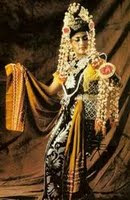 For a brief description, this dance describes teenage daughters beautiful playing in the garden of flowers. They picked some flowers and then assembled into flower blossoms bogam then they bring this bogam enjoying themselves while dancing with a supple. Baksa Kembang dance wear named Elephant Gemuling crowns carved by the flowers that shake, a pair of small bogam flowers placed on the crown and strand woven from coconut leaves called halilipan. Baksa Kembang dance is usually danced by a number of odd count as one person, three people, five men and so on. And is accompanied by a set dance or gamelan tetabuhan to the tune of the song is standard sieves and Janklong or Kambang Muni.
 Baksa Kembang dance is in the Banjar society there are several versions, this happens every offspring has an individual style but is still a characteristic of the dance Baksa Kembang, like Lagureh, TAPUNG Rope, Kijik, Jumanang. In the 1990s, South Kalimantan Cultural Park gathering berinisiaf dance coaches from all Baksa Kembang to make a version of Dance Baksa Kembang standard. Once there is agreement, then the Dance diadakanlah workshoup participants Baksa Kembanag with representatives from local districts and municipal in South Kalimantan. Although there was a dance dance Baksa Kembang existing version but only revolves around the family or local, but in competitions, festivals or artistic mission out of the South Kalimantan have been dancing for a standardized.


